Adoption
Fostering an adult Rottweiler
The foster home as an observation post, with the observation grid nobody hands out: what to note, what to pass on, how to let go.
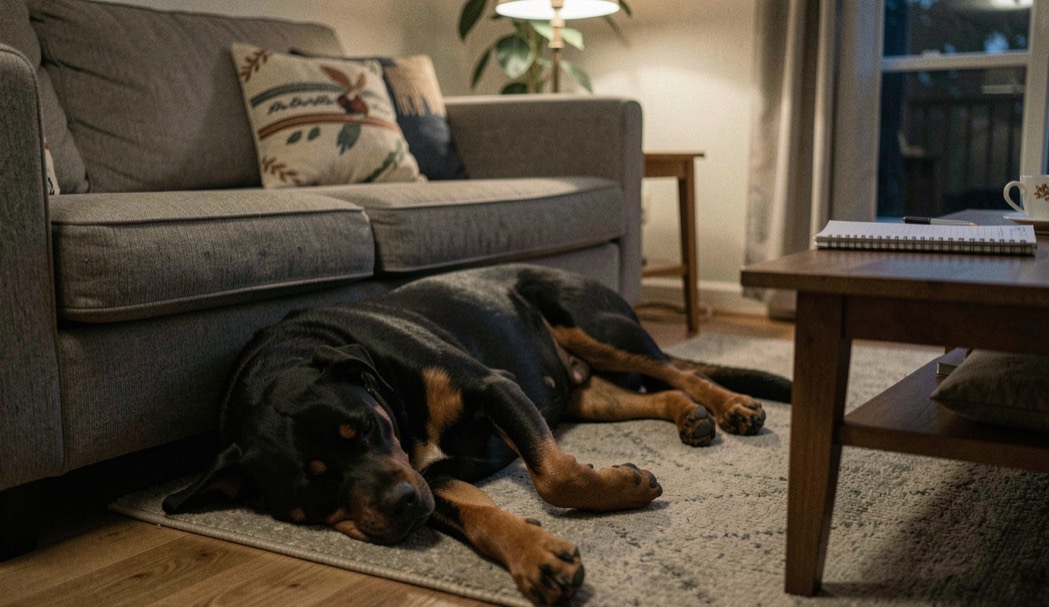
A foster household is usually described as a kindness, which it is, and seldom described as what it is operationally: an observation post. A dog that arrives in foster care is a dog nobody can write a truthful page about yet, and the foster household is where that page gets written. The work is measured in notes rather than in training, in patience rather than in progress, and the quality of those notes decides a good part of what happens next, because the adoption file that follows the dog out of the house is built from them.
What the first two nights change, measurably
The measurable part arrives before anything a household does. A study published in 2019 across five American shelters followed shelter dogs moved briefly into foster settings and measured four things: urinary cortisol, resting pulse, the share of time spent resting, and the longest single stretch of uninterrupted rest. The finding that matters to a new foster household is the last one. Across every site in the study, the dogs’ longest uninterrupted rest of the whole period fell during a foster stay, even when the stay lasted only a night or two. Nothing in a notebook improves on that measurement, and nothing a household does manufactures it either. A dog that finally sleeps a long, heavy sleep is a dog whose body has decided the room is safe, and the sleep itself is the datum.
It also sets the tone of the first week. The milestone worth waiting for is that first long sleep, and it waits on conditions rather than on effort: low light, few visitors, a room where nothing happens. A household that stages a busy welcome weekend postpones the very measurement it is hoping for, and then reads the tired, startled dog it produced as evidence of a problem that never existed.
The seven things worth writing down
The grid below is the one nobody hands out, and it fits on a page taped inside a cabinet door. Seven lines, written daily at first and every few days once the pattern holds:
- Sleep: where the dog slept, how long, and what woke it.
- Food: what was offered, what was eaten, how fast, and whether the dog ate in the same room as other animals.
- Water: how much, and whether drinking changed with weather, exercise or worry.
- Elimination: frequency, accidents, and where the dog chose to go.
- Handling: how the dog took a collar, a harness, a wiped paw, a looked at nail, a moved bowl.
- Meetings: dogs on walks, people at the door, children, and how the first seconds went.
- Alone: what the dog did in an empty room for ten minutes, and what the household came back to.
Together the seven lines are the difference between a household that remembers a fortnight as broadly fine and a file that can answer a coordinator’s specific questions two months later. The file is the product. The fortnight is the workshop it was made in.
Describing a dog without selling it
The notes travel, and the way they travel matters. A description written to place the dog advertises; a description written to inform reads like weather. Behaviors rather than verdicts: an entry that says a dog guards chew bones and gives them up when asked twice tells a receiving household what to manage, while an entry that says protective tells it nothing and attracts or frightens it for the wrong reasons. The same discipline keeps the hard facts in the file where they belong. A dog that guards its food can be placed well once the receiving household knows, and a note that leaves the fact out takes the choice away from the one person able to use it. The vocabulary for the hard entries comes from body language of fear, and it keeps descriptions level where adjectives let them drift.
Resident animals and the first fortnight
A foster home with animals of its own runs the fortnight on three rules. Space first: the foster dog gets a room, a crate corner or a quiet end of the house where nothing needs negotiating. Scent before sight: bedding moves between the animals before faces do, and the first meetings happen on leash in the most boring room of the house. Supervision without ceremony: the dogs are together when someone is watching and separated when nobody is, with no speech made about it either way. What gets recorded is the arc rather than the incidents alone: the day the resident cat stopped leaving the room, the meal the two dogs ate in parallel without a glance, the game that started by itself in the second week. That arc is the sentence a receiving household actually needs, and it cannot be reconstructed after the dog has gone.
Preparing a handover
A handover is a document exchange before it is a goodbye. What moves with the dog: the veterinary record and the dates of everything done in care; the food the dog has been eating and the amount; the words the dog knows and what each one means in practice; the sleeping arrangement that has been working; the notes of the grid above; and the small physical facts that never reach a form, which door the dog waits at, which floor makes it slip, whether it rides a car like a passenger or like cargo. The receiving household inherits thirty days of pattern, and the calendar of what to keep doing and what to watch is the first thirty days, written to be handed over with the dog rather than kept in the drawer.
The part nobody warns you about
The part that surprises foster households is that the job succeeds by ending. A dog settles, the notes fill a file, and the file leaves the house with the dog in it. The pull to keep the first foster dog is real, and some households should. Most do not, because the arithmetic is blunt: the number of homes willing to hold a strong adult dog for a month is the true ceiling of the whole system, and how a breed rescue works runs that arithmetic in plain terms. What keeps households fostering is usually the file itself, which is the other half of the same job: the next dog arrives with no page at all, and someone has to write it well.
Seen from the applicant side, all of this runs behind the curtain: what a future household meets as a reference call and a home visit is the notes above, in motion. The two ends of the exchange are one process, and the adoption process is where the receiving side of it is written out step by step.