Survey 02
Rottweiler Health: What Can Be Measured
Health in this breed sorts into three families: what an exam can measure, what medicine can treat, and what an owner can only watch. Each family has its page.
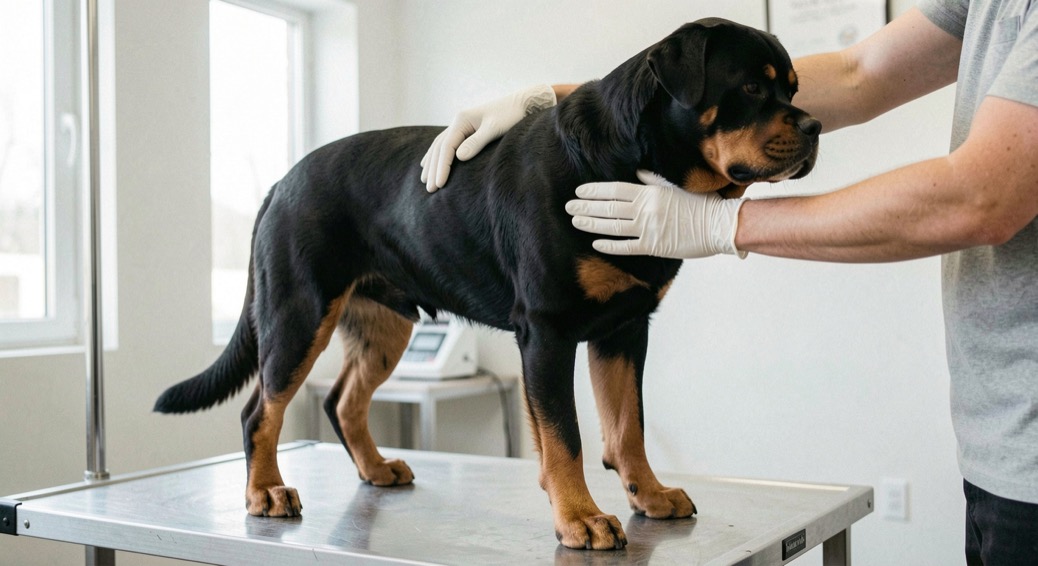
Health talk about this breed runs on two opposite errors. The first treats every Rottweiler as a diagnosis waiting to happen, a list of conditions in search of a dog. The second treats the breed as unbreakable until a crisis proves otherwise. Both errors come from the same source, which is talk without measurement. This survey is built the other way around, from the exams and the documents, and it sorts everything it covers into three families, because the family a question belongs to decides what an owner can actually do about it.
What an examination can measure
The first family is the one with a calendar attached. The breed’s parent club publishes a set of screening requirements for breeding animals, and those requirements are also the best map an adopter of a grown dog can hold: hips read from radiographs at twenty four months or older and graded on a seven step scale, elbows read from the same images, a cardiac clearance at two years or older, an eye examination whose certificate is valid three years, and a DNA test for JLPP that a laboratory can run at any age. The ages matter as much as the exams, because a reading taken early stays provisional and a reading taken late is final for life. The whole panel, read from the adopter’s side with the ages and the readers named line by line, is the adult screening table, and it is the resource the rest of this site cites first.
What the grades mean and how to read them
A result is a document, and the second family of the survey teaches the vocabulary of those documents: how the seven hip grades descend from Excellent to Severe, why each radiograph is read by three reviewing radiologists, how the American grades line up against the letter ratings of the continental systems when an imported dog arrives with paperwork full of letters, and why an unflattering elbow result published in a registry is an ordinary event rather than a hidden shame. That decoding work, grade by grade and letter by letter, is hip and elbow dysplasia. A household that can read a result stops being hostage to somebody else’s summary of it, which is the entire reason the survey spends a page on reading before it spends a line on worrying.
What medicine watches and what it treats
The third family is the hardest, and the survey treats it with the most care. Two diagnoses weigh on this breed more than the rest: osteosarcoma and lymphoma, the bone cancer and the lymphatic cancer whose lifetime figures come mostly from a cohort studied two decades ago and quoted with that date every time. The measured claims, the sample sizes and the limits of those old numbers are laid out in bone cancer and lymphoma. Beside them sits a timing question that a household sometimes gets to answer once: when to alter, and what the largest cohort of the breed actually measured about joint disorders by age of alteration, quoted subgroup by subgroup exactly as published, in neuter timing. Neither page issues orders; both prepare a conversation with the veterinarian who can see the dog.
The limits of the survey
A magazine measures documents, and a veterinarian examines dogs, and the survey stops exactly where the examination begins. What these pages do is make the reader fluent: in the exams worth ordering, in the ages that make a reading final, in the grades and letters a result arrives written in, and in the difference between a figure a study measured and a rule nobody sourced. Fluency is not a small thing. The household that walks into the first appointment knowing what a fair grade looks like, why an elbow result is published whatever it says and which certificate carries an expiry date asks better questions and gets better answers from the same fifteen minutes. When something on these pages moves in the source documents, a dated entry records it in the notebook, so a reader can check whether the line they remember is still the line the document supports.
The other doors of the magazine: The Breed, Adoption, Training, Law and Insurance and Notebook. Every one of them points back to the screening table.
In this section
3 pages, newest first.
-

HealthAugust 18, 2026
Osteosarcoma and lymphoma in Rottweilers
The two diagnoses that weigh heaviest in this breed, treated through what an owner can observe and decide, with the end of life welcomed plainly.
-
HealthAugust 18, 2026
When to spay or neuter a Rottweiler
Neutering age as a trade between two measured risks in this breed, with the cohort size next to every percentage, never as a universal rule.
-

HealthAugust 18, 2026
Hip and elbow dysplasia in Rottweilers
Reading a grading document, converting it between systems, and deciding what to do with a limping adult: the one thing this cluster never finds in plain language.