Training
The body language of fear
Reading fear on a dog whose broad head, heavy flews and dropped ears blur most of the signals the general literature describes.
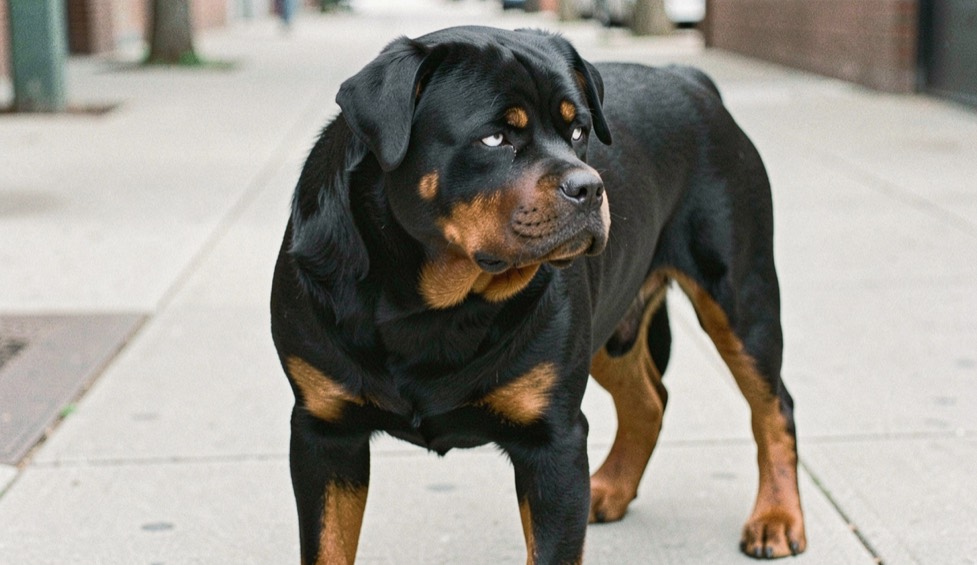
A growl gathers the whole room, and it is also late. By the time a Rottweiler growls, the dog has usually said the same thing several times in a quieter alphabet, and each of those earlier sentences was legible to a person who knew where to look. This page is about the earlier alphabet: the signals that walk in front of an incident, read on a head built in a way that hides most of them. A broad skull, heavy flews, dropped triangular ears and tan eyebrows set over dark eyes make a magnificent head and a poor telegram. The American standard even fixes the proportions of that head, skull to muzzle as 3 is to 2, and nothing in either official text promises that a visitor can read an expression on it.
The stakes are practical rather than sentimental. An owner who reads the shut mouth and the frozen body can end an incident ten seconds before it exists, by moving the dog, moving the visitor or moving the object. An owner who reads only the growl arrives at the last line of a story already written, and usually blames the dog for skipping the earlier pages. Neither owner loves the animal more. One of them simply has the vocabulary, and the vocabulary is learnable in an afternoon on a dog you already live with.
The ladder, and why it is read too late
Trainers teach escalation as a ladder, and the metaphor earns its keep. The lower rungs are quiet: a head turned away, a lick of the nose, a yawn out of context, a paw lifted, a body that angles sideways while the eye keeps its target. The middle rungs stiffen: the mouth closes, the weight shifts back, the tail drops or starts moving fast in a narrow arc, the white of the eye shows at the corner. The upper rungs are loud: the freeze, the growl, the air snap, the contact bite. Households learn the upper rungs first, because those are the rungs that interrupt a dinner. The trouble is that the upper rungs only exist because the lower ones were missed, and a dog whose quiet signals have been ignored for months climbs faster each time, until the household believes its dog went from calm to furious without warning. The warning was there. It was spoken in a vocabulary nobody in the room could hear.
| The signal | What it usually indicates | What to do inside the minute |
|---|---|---|
| Head turned away, nose lick, yawn out of place | A request for space, made quietly and usually missed | Increase the distance without ceremony; the request has been granted |
| Body angled sideways, eye holding its target | Conflict between wanting to leave and wanting to watch | Stop the approach and let the dog finish choosing |
| Mouth closed, flews pushed forward | Arousal replacing relaxation, with a decision close behind it | Move the trigger, or move the dog behind a door it can settle behind |
| White of the eye showing at the outer corner | A dog holding still because it is unsure what comes next | Step out of the line of the eye, turn sideways, open an exit |
| Tail low and fast in a narrow arc, or frozen horizontal | Worry in the first case, a decision already made in the second | Distance first; handling waits until the body softens |
| The freeze, then the growl | The last two notices before contact | End the moment, then write down what led to it |
Read the table from the top down and it describes a dog buying itself space: each line is a request that something stop, made a little louder than the one before it. Read it from the bottom up and it describes a history, the rungs a particular dog has already climbed in a particular house, and the speed at which it has learned to climb them.
Eyes, mouth and the pause before anything
Three pieces of the head carry most of the information, and all three reward close attention. The eyes: a worried dog holds its head still and moves only its eyes, which drags the white into view at the outer corner, the half moon trainers call whale eye. On this breed the white flashes against the tan marking above the eye, and it reads most clearly from slightly to the side, which is exactly where a person standing over a dog is standing. The mouth: a relaxed Rottweiler carries an open, soft mouth with the heavy flews hanging loose, and the change to watch is the mouth that closes, the lips that push forward into a pucker, the corners drawn long and tense. And the pause: the dog that stops in the middle of something, mid drink, mid greeting, mid sniff, and holds. A pause without an obvious cause is a dog taking a reading on the room, and it is the most valuable signal on the list, because it is the one that arrives with time to spare.
Tail carriage on a dog with a natural tail
A natural tail is a fast, honest instrument, and this breed still carries one often enough that it is worth learning: the European standard describes the tail in its natural condition, and the American text states that the set of the tail matters more than its length. Carriage does the talking. A tail carried low and moving fast in a narrow, stiff arc belongs to an unsure dog rather than a delighted one. A tail clamped down and still belongs to a dog holding itself together. A tail horizontal and rigid, with the hair along the back lifted, belongs to a dog that has made a decision about whatever it is facing. The loose, wide wag that starts at the shoulders is the only tail state that reliably means welcome, and it moves the whole rear half of the dog with it. An owner who learns one thing from this page could do worse than the tail: it is visible across a yard, in the dark, and from behind, which is more than can be said for the eyes.
Why a broad head hides half the signals
Much of the general writing on canine signaling was shaped by dogs whose faces broadcast: pricked ears that swivel and stand, light eyes, mobile lips, a long muzzle that wrinkles visibly over the lip corners. Swap in this breed and half the channel goes quiet. Pricked ears turn and lift; the dropped triangular ears of a Rottweiler pin back along the broad skull and read as nothing at all from ten feet. Light eyes show white generously; a dark eye set wide in a broad head shows it only when the head turns. The tan eyebrows hold the eye region in a constant expression that never varies with mood, and the heavy flews cover the mouth corners that carry the longest lip signal. Even the resting state misleads, because the European standard describes a good natured dog, placid in basic disposition, and a placid dog at rest already looks like the picture people carry of calm. On this breed the signal is the change, never the state, and a person who has watched the dog for a week knows what its neutral looks like. A guest who met the dog an hour ago does not, which is why the guest is the person the owner watches on the dog's behalf.
The ten seconds you just bought
Reading the signal buys time, and time converts into distance. Inside the minute: stop approaching, and turn your own body sideways so the dog is no longer face to face with a square on stranger. Give the dog a route away that does not pass close to whatever worried it, and let the leash stay slack, because a tight leash reads as the handler bracing and confirms the worry. Move the trigger instead of the dog when the trigger is an object. Speak in the ordinary register of the household, briefly, and do not loom, do not reach over the head, do not take hold of the muzzle. Then, once the dog has settled, do the part most households skip: write down what happened, what was within a few feet, who was moving and in which direction. Three such notes show a pattern that a memory never will, and the notes are the first thing any competent trainer asks to see.
What punishing a growl actually removes
A household that punishes the growl believes it has removed the danger. It has removed the announcement. The dog that was growling at the approaching hand and is now silent has not stopped worrying about the hand; it has lost the cheapest rung on its ladder, the one that cost nothing to say and nothing to hear. A dog corrected for signaling does not become comfortable around the thing that worried it. It becomes quiet about it, and the next notice the household gets may be a snap with no sound in front of it. The alternative costs more patience and less grief: treat the growl as information, take the dog out of the situation without ceremony, and change the situation so the same information is not needed again tomorrow. A growl that is answered has done its job, and a dog whose signals are answered keeps signaling, which is the safest thing a large dog can do in a house full of people.
Misreadings that cost households their warning lights
- A wagging tail means a happy dog. Speed, height and stiffness carry the meaning; a low fast wag is worry, and a rigid horizontal tail is a decision.
- Whale eye means a guilty dog. It means a dog holding still because it is unsure what happens next, usually while someone stands over it.
- A dog that has never growled is a safe dog. A dog whose growls were corrected has learned to skip the step, which is a different and harder situation.
- Dropped ears and a shut mouth read as calm at a distance. On this breed the resting face is already still, so the state tells a stranger nothing and the change tells the owner everything.
- Tolerance means comfort. A dog that puts up with a hug is spending a budget, and the household that knows the budget never watches it run out.
The vocabulary on this page does its first real work during the first thirty days, while a new dog is still deciding what the household is. It is also the toolkit of fostering an adult dog, where the notes a household writes become the record the next home reads, and the terms themselves, from whale eye down, are defined once in the glossary. Reading a signal as a fact about the present rather than a symptom of a past nobody documented is the frame set out in adopting an adult dog. Both belong to the wider work of training and behavior, which starts here and nowhere else: with reading, before correcting.