Adoption
Adopting across state lines
The multi state footing of the domain, turned into a moving checklist: what follows the dog, what follows the address, what gets redone.
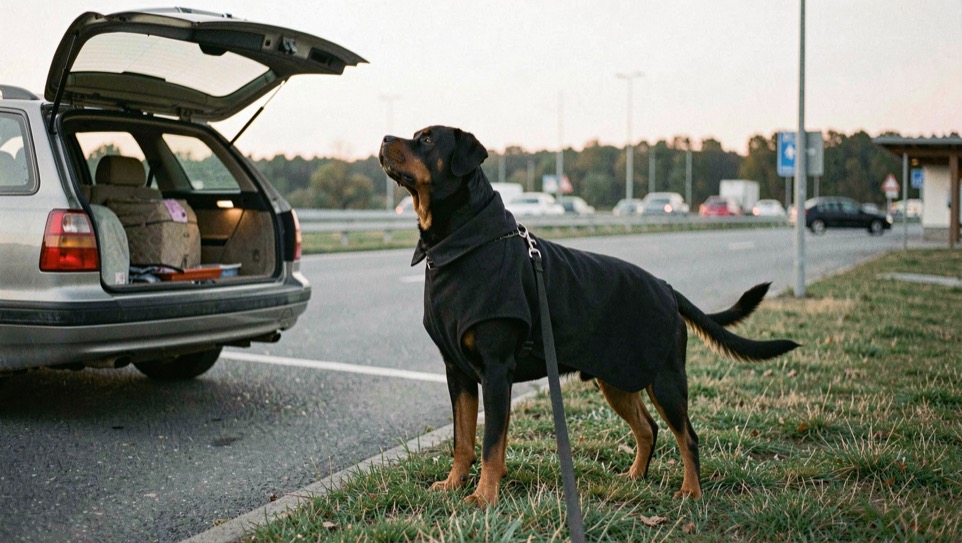
The Southeast moves its dogs long distances. A Rottweiler adopted in Greensboro may have been whelped in South Carolina, held in a Virginia foster home and transported through Maryland, and every mile of that trip crosses a boundary where a different set of rules starts. The animal does not change at the line. The paperwork does, the insurance does, and the municipality does, and the household that sorts those three apart before the trip is the household that does not discover a missing document halfway through it.
What travels with the dog
The dog’s own paper is portable by design. The veterinary record moves as copies, with the original left where the next veterinarian can request it. The microchip number and its registry follow the dog everywhere, which is why the registration is worth checking before the trip rather than after. A current rabies certificate is the single document most often asked for at the other end of a crossing. A designation under the state’s dangerous dog law also changes the trip rather than the animal: the precautions an owner owes under G.S. 67-4.2 are owed by the owner of a designated dog, and the strict civil liability of G.S. 67-4.4 follows that ownership. The safest reading of a move is that a designation and its obligations come along, and that the new county is the place to confirm the local mechanics of them. What does not travel is anything the dog was never given: a license issued by one town belongs to that town, and a registration in one state is paper in the next.
| Item | What follows the dog | What follows the address |
|---|---|---|
| Medical | Records, rabies certificate, chip registration | The new veterinarian of record |
| Legal status | The owner’s obligations under a dangerous dog designation | License, registration, leash and nuisance ordinances |
| Money | Nothing | The underwriting of the household at the new address |
| Daily life | The routine the dog already knows | Yard, surfaces, neighbors, the sounds of the street |
What belongs to the address, not the animal
Rules of the second kind are rules of place. Leash lengths, nuisance ordinances, limits on the number of animals per household, and the local reading of a generic dangerous dog provision all attach to the door the dog lives behind, and two counties on either side of a line can handle the same animal differently. Insurance belongs in this company rather than in the dog’s folder: a household moving with a Rottweiler is moving into a new underwriting question, and homeowners insurance explains how a restricted breed list is written and what a refusal can be met with. A few states have legislated against refusals based on breed alone; Minnesota’s statute (65A.303) is one such text, read here as an example of the drafting rather than as a list. Check the current law of your own state before relying on any list that circulates, because the list moves.
Rabies documents and the certificate that must be current
Rabies is the one subject where the paperwork and the law meet at the collar. North Carolina requires rabies vaccination, and the certificate that proves it is the document a new veterinarian, a new county and often a new landlord all end up asking about. The details vary by jurisdiction and they change with sessions, so confirm the current requirements with your veterinarian, and read the certificate itself for what it says about the animal, the vaccine and the date the next one falls due. What matters for a move is the rhythm rather than the recital: a certificate about to lapse crosses a state line and becomes an errand, and the errand is far simpler to run in the first week at the new address than in the middle of something urgent.
Transport: heat, breaks and restraint
Transport in the Southeast is a heat problem before it is a distance problem. A black coat absorbs what a light one reflects, so a leg that has to run at midday runs with air moving, water in the cab and stops planned in shade; asphalt and metal bed liners hold surface heat long after the air has cooled, and the dog that stands on one is the dog that burns its feet. Restraint is the other half of the same sentence: a harness or a secured crate fitted before loading, a lead that lives in the same bag as the papers, and never a loose dog in an open vehicle. Breaks do double duty, water and a walk on grass away from traffic, at whatever interval the day asks for. The dog that has traveled all day arrives with a body that needs an hour of boring before it needs a tour of the house.
- Papers in the cab: rabies certificate, a copy of the medical record, the chip number, the receiving veterinarian’s address.
- Water, bowls, and the lead that stays with the papers.
- Restraint fitted before loading rather than argued about after.
- Stops in shade, on grass, away from traffic, as often as the heat asks.
- The first errand at the new address: the license and the new veterinary file, both inside week one.
The first week at the new address
Arrival restarts the clock. A dog that had three settled weeks in the old house meets the new one as a stranger: new surfaces underfoot, new sounds through the walls, a different door to the yard, and neighbors whose dogs sound unfamiliar. The calendar of an arrival month is written for exactly this situation, and the first thirty days is where it lives: quiet first days, one new room at a time, the veterinary appointment of the first week, and the slow widening of walks. Two things deserve emphasis after a transfer. The registration and license errands of the new address run best in that first week, while motivation is high and the papers are still in the bag. And the dog’s sleep, the first honest measure of how an arrival is going, usually takes longer to settle after a long trip than after a plain placement, which is a reason to keep the calendar rather than a reason to worry.
Reading a state rule before you rely on it
The habit that keeps a household out of trouble is reading the text rather than the summary. Statutes are public, they cite themselves, and a rule that matters enough to plan around is worth finding in its chapter: in North Carolina the dangerous dog provisions sit in chapter 67, article 1A, with the definitions and the designation procedure at G.S. 67-4.1. A secondhand source that names a county ordinance is a lead rather than a fact until the ordinance itself has been read in the municipal code. The same discipline applies to anything a landlord, a neighbor or an insurance quote asserts about the law, and North Carolina dog law keeps the state text and its article numbers on one page for exactly that reason.
For the household that is moving because a dog is arriving rather than the other way around, the transport leg sits in the middle of a longer sequence, and the adoption process is where that sequence starts.