Health
Hip and elbow dysplasia in Rottweilers
Reading a grading document, converting it between systems, and deciding what to do with a limping adult: the one thing this cluster never finds in plain language.
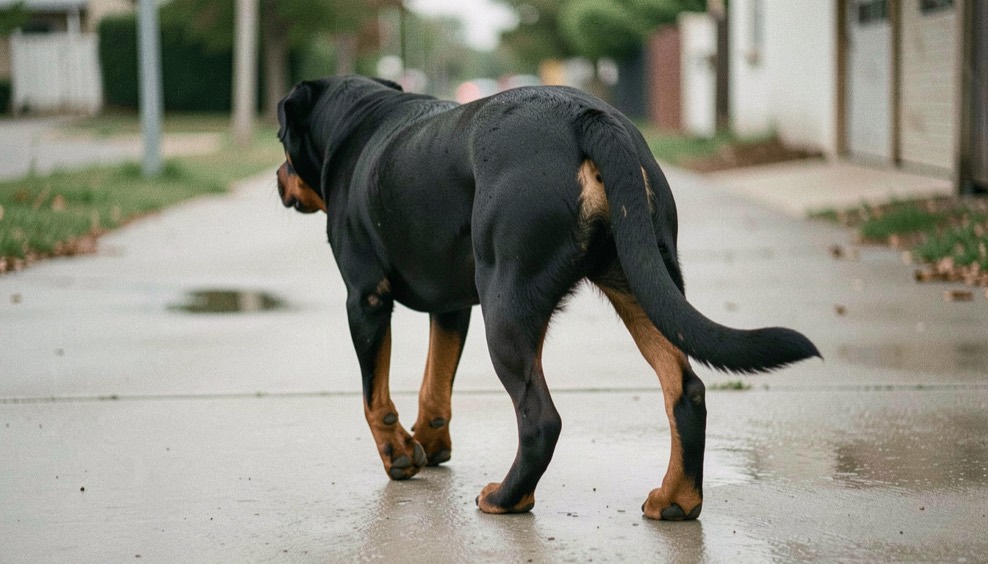
Somewhere in the paperwork of a Rottweiler there may be a document that describes two joints in a vocabulary of seven words. It comes from an orthopedic registry, it is usually photographed or photocopied by the time it reaches a new household, and it is the most misread piece of paper in the breed, because everyone agrees it matters and almost nobody says how to read it. This page reads it: what a grade describes and who assigns it, why one age in particular governs it, how it translates into the letters a European document carries, what makes the elbow a different exercise, and what a household with a limping adult dog actually does first.
What dysplasia is, and what it is not
Hip dysplasia is an abnormality in the way a hip joint develops: a joint that does not seat the way it is drawn, with consequences that accumulate over a lifetime of carrying a heavy body. It is not an injury with a date on it, and it is not a condition a household can diagnose by watching a dog cross a kitchen floor. It is also not a verdict. A grade describes a joint on a radiograph rather than a dog’s future, and the distance between the best reading and the worst holds animals that work full lives at one end and animals that need lifelong management at the other, with most of the breed living somewhere in between. How common it is in the breed is a live statistic: the registry that issues the grades publishes current breed statistics and updates them continuously, and the Rottweiler page of its site carries the figure with its own date. This magazine prints no percentage of its own without a dated reading of that page. The measurement that is fixed belongs to the 2020 cohort from the University of California, Davis: joint disorders in 8 percent of its 315 intact males and 16 percent of its 143 intact females, a reminder that in this breed the question reaches dogs that were never operated on and never bred.
The seven grades and the three readers
The registry grades a hip radiograph on a seven step scale, from Excellent at the top through Good and Fair, then Borderline, then the three dysplastic readings of Mild, Moderate and Severe. Two features of the reading matter as much as the grade itself. The first is that the radiograph is read by three radiologists rather than by one reader, which keeps a grade from hanging on a single eye. The second is that a grade describes the radiograph, and the radiograph describes the joint on one day. Both are reasons to treat the document as a reading rather than as a biography of the dog, and the table below is the whole scale with the one line every breeding discussion turns on.
| Reading | Where it sits on the scale | Accepted by the breeding practices |
|---|---|---|
| Excellent | Top of the scale | Yes |
| Good | Upper band | Yes |
| Fair | Lowest step of the passing band | Yes |
| Borderline | Between the bands | No |
| Mild | First of the dysplastic readings | No |
| Moderate | Second of the dysplastic readings | No |
| Severe | Bottom of the scale | No |
The parent club’s mandatory practices, as most recently published (2019 version consulted in 2026), accept a hip certification of Excellent, Good or Fair on a dog of 24 months or older. Everything below Fair is a reading that a breeding program works around, and Borderline is the reading in the middle that people argue about: below the passing band, above the dysplastic grades, and worth nothing at all if it is described as either of the two things it is not.
Twenty four months, and why earlier readings are provisional
Definitive certification starts at 24 months. Before that age a radiograph can be taken and read, and the reading stays provisional, because the joint is still finishing the work of becoming a joint. That single date explains most of the confusion in discussions about puppies, where a reading taken early is waved around as a clearance or as a condemnation when it is in fact neither. The same age governs the elbow side of the panel, and the rest of the panel runs on ages of its own: a cardiac clearance at two years or older, an eye certification at two years or older and valid for three, and the DNA test for JLPP on every breeding dog, with the results published in a registry entry rather than held in a drawer. The ages, the exams they belong to and the decision each one feeds are collected in the screening table, which is the page this one summarizes in its own two lines.
Converting an American grade to a European letter
An imported dog, or a dog whose paperwork was issued in a continental system, describes the same joints in letters: the FCI scale runs from A at the top to E at the bottom. The registry that issues the American grades publishes the grid that lines the two systems up, alongside the national systems of other countries, and the grid is the only place a conversion should happen. Converting by ear is how a Good becomes an A at a dinner table, and the error always travels upward, which is the direction that costs somebody money or costs somebody a dog.
What the grid is for is a practical question rather than a technical one. It is how a household reads a European document as an American buyer, how an American dog is presented in a European context, and how the paperwork of one litter is compared across a border. The correspondence also explains a quiet feature of the American scale: it grades in adjectives rather than in verdicts, so the word normal that a reader expects to find on the document is a translation and not a term. Keeping the two systems separate, and reading each against its own rule, is the whole discipline. The grid itself, with its publisher and its reading date, sits in the primary documents, and the same international gap runs through the description of the dog itself, which is the argument of the two standards.
Elbows: a different joint, a different reading
The elbow is evaluated under the same panel and at the same age as the hip, and the two results are still not interchangeable documents. The hip reading has to land in the top three grades for the breeding practices to accept it. The elbow result is published whatever it says, which is a different rule doing a different job: a hip grade certifies, an elbow result reports. For a reader holding both papers, the consequence is that silence means different things on the two documents, and that the absence of a flattering grade is ordinary on one of them and decisive on the other. It is also why this page declines to compress the two joints into a single piece of advice. They share a visit, an age and a registry, and they still travel under separate rules, and a household that reads an elbow document the way it reads a hip one has misunderstood both.
A limping adult dog: the order of operations
A limp in a grown Rottweiler has two large families of explanation, a joint that developed unevenly and everything else, and the order of operations follows from that. The reading comes first, because watching decides nothing: an image of the joint answers the structural question, and the conversation with a veterinarian turns the answer into a plan. What an owner controls sits on either side of that appointment, and the parts that belong to the household are worth doing in the same week rather than after the reading, because none of them depends on the result:
- The weight, read by condition rather than by the scale’s memory of the breed: the target on a clinic card comes from the dog in front of the veterinarian, and the number in a standard describes a population.
- The floors: a heavy dog turns at speed, hard floors slide, and the routes the dog actually uses are the ones that take the rugs and the runners.
- The walking: the same distance every day rather than nothing all week and a long walk on Saturday, on surfaces chosen rather than inherited.
- The access: the furniture, the stairs and the car are worth looking at once, honestly, for the way the dog uses them when nobody is watching.
And a limp that does not resolve, in a forelimb above all, is the description this page hands over rather than keeps: a limp with no accident behind it belongs to a different chapter, and bone cancer is where that chapter is written. Where the age of alteration enters the same risk arithmetic, the trade is laid out with its cohorts in neuter timing. A household whose dog needs a specialty reading also has the route inside the state: North Carolina State University’s veterinary college is a public institution with orthopedics and oncology services.
Misreadings of a grading document
- A grade describes the radiograph, and the radiograph describes the joint on one day. It is a reading, and a reading is not a biography.
- The parents’ results describe the parents. A puppy out of graded parents inherits nothing final, and the dog’s own reading waits for its own age.
- Borderline is neither certification nor disease. It is the reading between the bands, and it is not one of the three the breeding practices accept.
- Letters and adjectives are two languages for the same joint. The registry’s grid converts between them, and rumor converts only upward.
Read in that order, the paperwork stops being a verdict and becomes what it is: one day’s reading of two joints, under rules the registry publishes and keeps current, with three readers standing behind the grade and one age standing behind the date on it.