The Breed
Before you get a Rottweiler
Six questions that settle themselves before the arrival, from the weight the standards describe to the insurance call that decides more than any trainer.
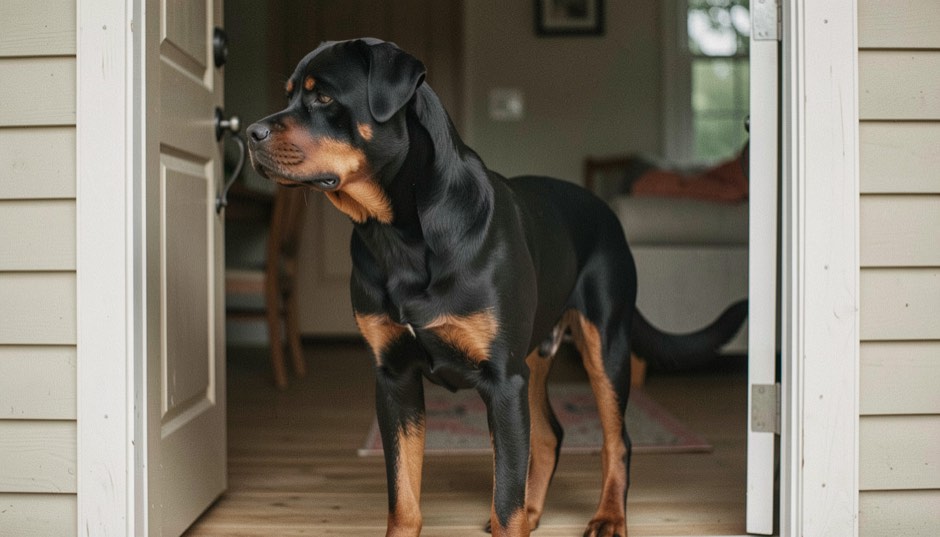
Most of what decides a Rottweiler household is settled before any dog is in it. The breed brings a large, strong animal with a working temperament and an opinion about the front door, and a household either has room for that in its ordinary week or it does not. None of it is decided at the moment of meeting a dog; it is decided at the kitchen table, on the phone with an insurer, and in the doorway where the dog will have to turn around. The six points below are the ones that separate the placements that hold from the ones that come back, and every one of them can be closed before anything is signed.
- Read the size the standards describe, and notice that only one of the two texts is willing to print a weight.
- Decide who handles the dog, hour by hour, on an ordinary Tuesday in January rather than on the best afternoon of a holiday week.
- Walk the house as the dog will walk it: doors, stairs, floors, the fence at its weakest section, and the corner where it will actually sleep.
- Price a year rather than a month, and include the categories that arrive whether or not anything goes wrong.
- Make two calls before every other call: the insurer about the household policy, and whoever holds the papers of the address.
- Decide what a guarding temperament will ask of the household, and which adult in it is going to do that work.
The size the standards actually describe
The two official texts describe a big animal, each in its own units, and the description is the first honest thing to hold. The FCI standard (no. 147, 2018) sets males at 61 to 68 cm (50 kg) and females at 56 to 63 cm (about 42 kg). The AKC standard gives 24 to 27 inches for males and 22 to 25 for females, prefers the middle of the range and lists no weight at all. The gap is not sloppiness: one text is written for a continental ring culture that expects a dog in show condition to carry a stated mass, and the other declines to print a figure that a household will read as a target. A target weight on a clinic card comes from condition scoring of the dog in front of the veterinarian, and the two texts behind those numbers sit side by side in the two standards. The AKC places the breed in the Working Group, its classification for dogs kept for jobs, and the AKC profile for the breed carries the figure for lifespan; this page leaves that figure at its source, because a range that moves belongs to the document that maintains it.
A guarding temperament is not a training problem
The standards agree on the temperament in substance while wording it differently. The FCI text lists the breed as good-natured, placid in basic disposition, very devoted, obedient, biddable and eager to work; the AKC text answers with calm, confident and courageous, and a self assured aloofness with strangers. Both lists were written for assessors watching a dog in a work or ring setting, and a household reads the same traits as watchfulness: a dog that notices who is at the door, that positions itself where it can see the room, and that waits for its person to decide whether a visitor is welcome. That behavior is the job the breed was kept for, and no course removes it, because it sits in the description rather than in the dog’s memory. What training changes is what the dog does with it, and the daily version of that work is what training and behavior covers on a dog that arrives already grown.
The household: doors, stairs, floors and children
Read the house at the height the dog will use. A Rottweiler turns in a doorway with its shoulders at handle height, so the traffic of a hallway runs around the dog rather than the dog around it. Stairs are a joint question before they are a convenience question, and the flight the household uses a dozen times a day is the one to measure honestly. Hard floors slide under a heavy dog at speed, which is why the corners where it turns matter more than the square footage of the rooms. Outside, a fence reads at its weakest section rather than at its average one, and a gate that leans is the part a strong animal will test. Children in the house change the arithmetic in a way no standard describes: the breed’s devotion to its own household is the trait both texts insist on, and the same devotion is why supervision runs on a schedule and on closed doors rather than on a mood. None of this argues against the breed; it is the list of what the household is actually offering.
Money over a year, not over a month
The spending that decides whether a placement holds is annual, and most of it arrives on schedule. Food scales with body mass, so the quantity a dog of this size eats is a category of its own in a monthly budget. Preventives are dosed by weight, routine veterinary care is priced in the same direction, and boarding or daycare charges for the size of the animal rather than for the size of its personality. Training classes run for months when they run well. Set against that are the one time examinations an adult dog can still take, which behave differently from a monthly cost because they arrive once and settle a question. A household that plans for the breed should also know where a specialty referral sits in the state: North Carolina State University’s veterinary college is a public institution with oncology and orthopedics services, and the time to learn the route to a specialty service is before the route is needed. The point of the exercise is not a total but a shape. A household that carries the recurring categories is ready for the breed, and a household that carries only the first month is not.
The two calls to make before anything else
The first call goes to the company that carries the household policy, and the question is narrow: whether the breed is on the company’s restricted list, what an exclusion would mean, and what the answer looks like in writing. Insurance is a private regime with rules of its own, and it does not follow the law of the state, which is why homeowners insurance is a page of its own rather than a paragraph here. The second call depends on the papers of the address. A tenant needs written permission that names the animal and states the terms, obtained before anything else is signed, because the lease is the one document that can end a placement after every other question has been answered. A household inside covenants reads the covenants the same way. Both calls are cheap to make and expensive to skip, and both come back during an adoption, where a reference call asks them again with a specific dog in view.
Who should not get this breed
The honest list is short, and it is about households rather than about dogs. A household whose hours alone run long and fixed will be working against the breed’s need for its people. A tenant whose lease cannot be amended is carrying an address that can outvote everything else in the plan. A household whose insurer has answered no, and whose address cannot move, sits in the same place from the other side. A reader who wants a dog that greets every visitor as a friend wants a temperament the standards do not describe. A reader who wants the dog for what it says about the reader is buying an image and handing the upkeep to the household. And a household that cannot give the daily handling a strong animal requires is offering the dog a smaller life than the standards promise. Breed rescue spends much of its year on the residue of answers like these, which is one more reason to give them before the dog arrives rather than after. Where a household clears the list, the next question is the fork that orders the rest of the site: puppy or adult.
Misreadings that cost households later
- The AKC standard prints no weight because the registry chose not to print one. A target weight on a clinic card comes from condition scoring, and the silence of one text is not permission to guess.
- Height is measured at the withers of a standing dog. A height read against a wall and a weight read on a scale are two different measurements, and neither one comes from a photograph.
- The Working Group placement describes the job the breed was kept for. It is a classification, and no household can read from it how much work its own dog will need.
- Guarding behavior that appears around maturity is the temperament both standards describe, and a dog that starts watching the door at two years old has been trained correctly.
Once the six points are closed, what follows is a process with a shape rather than a leap: the adoption process takes it step by step, from the long form to the contract, and the doorway in the photograph above is where that process usually ends.