The Breed
Puppy or adult: what each choice really asks
The two entrances into the breed, compared on what is knowable on day one rather than on sentiment: the unknown moves, it never disappears.
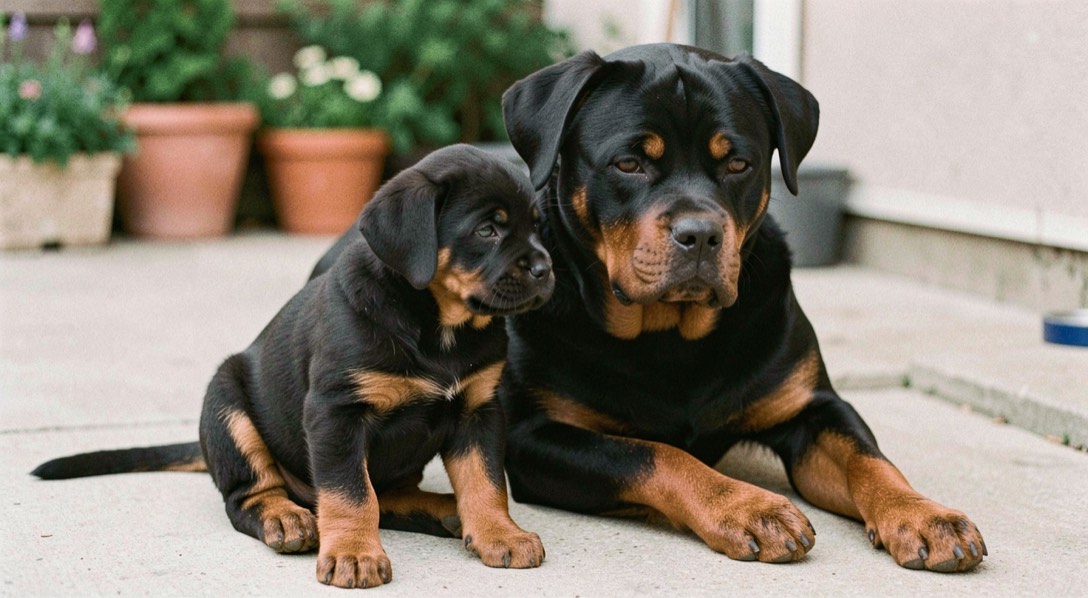
Two doors lead into this breed, and the difference between them is not sentimental. A puppy carries its adult size and its adult temperament inside it, and both stay hidden while the household is already living with the animal. An adult shows both on the first day, and instead hides the two or three years that made it. The unknown does not disappear with either door; it moves, and the practical question is which unknown a household would rather hold. This page compares the two entrances on what each one makes knowable: what day one shows, what stays out of sight, and what each choice lets you measure, and when.
| The question | With a puppy | With an adult |
|---|---|---|
| Adult size and build | Projected: broad head and heavy bone now, the height it reaches later | Known: the dog in front of you is the size it will keep |
| Temperament and drive | Forming, and shaped by the rearing that has not happened yet | Visible in outline: how the dog meets a stranger, a stair and a door |
| Joints, heart and eyes | Pending: the certification ages have not been reached | Readable where the exams have been done, repeatable where they have not |
| The history before you | Unwritten, and partly yours to write | Unknown in part, and owned by whatever came before the record |
| The alteration decision | A choice the household makes against a calendar of growth | Usually settled by the dog’s earlier keepers |
| The first year | A calendar of growth: visits, classes, a body changing under the training | A calendar of observation, with the routine doing the reading |
What is knowable on day one
An adult Rottweiler answers the physical questions in the time it takes to cross a room. Height, depth of chest, coat, the dropped triangular ears and the natural tail, the way the dog carries itself, and the way it handles a stranger, a stair and a closed door are all there on the first afternoon, and the standards describe that reading: the AKC text gives 24 to 27 inches for males and 22 to 25 for females, with the middle of the range preferred. A puppy answers none of it. It carries the breed’s head and bone in miniature, and it settles into a height and a temperament over roughly two years, which is the length of time the household is agreeing to live in front of a blank.
The two years a puppy keeps hidden
Growth hides more than size. Joints mature on their own clock, and the questions that weigh most in this breed are written against that clock. The parent club’s mandatory practices, as most recently published (2019 version consulted in 2026), require hip radiographs at 24 months or older with an orthopedic certification of Excellent, Good or Fair; elbows at 24 months or older, with the result published whatever it is; a cardiac clearance at two years or older with a Normal result, and an evaluation by a board certified cardiologist strongly recommended; an eye certification at two years or older, valid three years; and the JLPP DNA test on every breeding dog, with two carriers never bred together. Read those ages as a calendar and the picture is plain: the written answers to the breed’s orthopedic and cardiac questions arrive in the dog’s second year. A household choosing a puppy is choosing to hold those blanks while it raises the animal that will fill them, and a puppy out of certified parents inherits nothing that is final, because the parents’ results describe the parents.
The history an adult keeps hidden
The adult hands over its size and its manners and keeps its first years. A record can hold what somebody did: vaccinations with dates, the date of the alteration, a heartworm result, an injury and how it was treated, the clinics that saw the dog. It cannot hold the months before the record opened, and an adult that changed hands without a record holds only what its body and its behavior still carry. This is the unknown that replaces the puppy’s blank, and it is a different kind of unknown. It narrows when you ask for the file, when you read what a foster household observed, and when the dog lives in your house long enough for the routine to speak, but it never fills the way two years of raising a puppy fill theirs. Nobody takes either door without choosing which of the two unknowns to live beside.
Screening: what each choice allows
The panel reads differently at the two ages, and that difference is the argument of this page. On an adult the examinations have usually been run, or can be run now, and a result at four years old is final in the way a reading at fourteen months is not: the screening table sets out the five exams, the age each becomes final, who performs it and what a result changes. One decision sits on top of the panel and moves with the age of arrival, and that is the timing of the alteration. A 2020 UC Davis study covering 854 Rottweilers reported joint disorders in 8 percent of its 315 intact males and 16 percent of its 143 intact females, and gives guidance on neutering age sex by sex. A puppy household makes that decision against a calendar of growth, and an adopter of an adult usually inherits it already made; what the breed data supports at each age is laid out in neuter timing.
Cost and time over the first year
The two calendars spend differently. A puppy’s first year is a schedule of veterinary visits, preventives dosed for a body that keeps changing, food in a quantity that climbs with the animal, and classes that matter most in the months when the dog is forming its idea of the world. The household pays in money and in training hours, and the hours are the larger bill. An adult’s first month is paid in observation instead, on a schedule that starts at the door: what the dog does on the first day, in the first week and by the third week is a different kind of information, and the reading of it is the work of adopting an adult dog. The surgical question a puppy household plans for usually arrives settled with an adult, which closes one cost and one decision before the second door opens.
Deciding without romance
The choice goes wrong when it is made on the strongest image rather than on the clearest question. Answered in order, these close it:
- Do you want to meet the dog you will live with, or to raise the dog you hope for?
- Which blank can this household hold: the adult’s missing history, or the puppy’s unwritten temperament?
- Has the address said yes in writing, and has the insurer answered?
- Who runs the first month, and who runs the second year?
- What happens to the plan if the answer at 24 months is not the answer you wanted?
Misreadings that follow both doors
- A puppy out of certified parents is not itself certified. The parents’ results describe the parents, and the dog’s own written answers wait for its second year.
- An adult’s missing history is a blank rather than a verdict, and blanks narrow with observation and with the exams the dog can still take.
- Two years is not a promise of a finished temperament. It is the age at which the orthopedic and cardiac answers become final, which is a different statement.
- Growth does not read from paws. The size a puppy reaches is written in the standards, and the standards do not measure paws.
Both doors open onto the same household questions, and those come first: before you get one takes the size, the temperament, the money and the two calls that settle whether this breed fits the address at all.