Training
Why a Rottweiler does not live outside
A question asked every summer in the Southeast, answered with the physics of heat and the behavior of a guard dog left alone behind a fence.
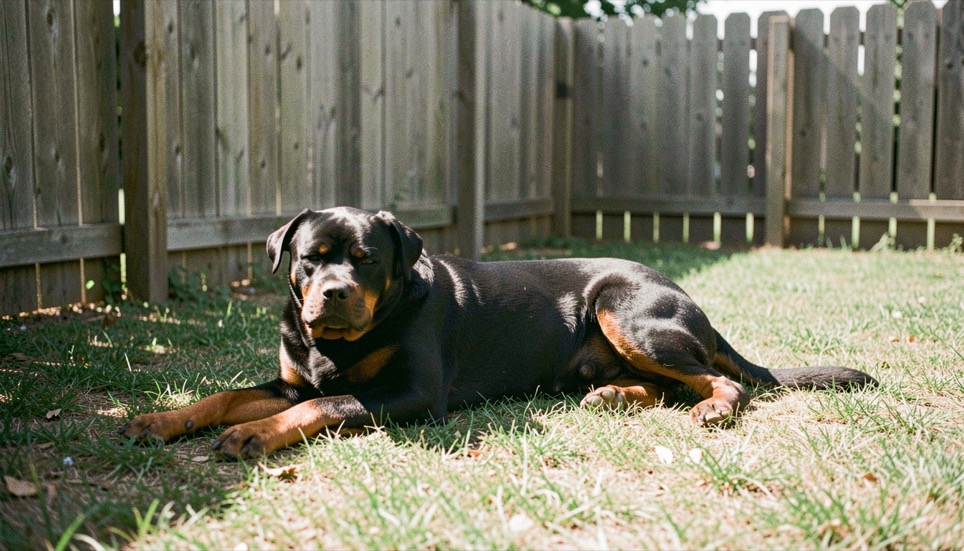
The question returns to the Southeast every summer, dressed as advice: a dog this size, a fenced yard, and a household that would rather not share its air conditioning. The honest answer is physical before it is moral. A Rottweiler is a compact, heavy animal in a short black coat with tan markings, a broad head and a deep chest, and a Carolina July is a humid test of exactly that combination. What the heat does to the dog, and what the yard does to the dog's behavior when the dog lives in it alone, are two different problems that share one solution, and the solution runs through the back door of the house.
A black coat in a Carolina July
Dogs cool themselves poorly, and this coat makes it worse. A dog has almost no sweat glands worth the name, so the whole cooling system runs through panting, which sheds heat only as fast as the air passing over the tongue and throat will carry it away. Humidity throttles that exchange, and Carolina humidity is the point of the question: a dog that would manage a dry heat can fail in a moist one at the same temperature on the dial. The coat finishes the job. Black surfaces take on more of the sun's load than light ones, and a short dense double coat holds that load against the body. Add the build, a heavy frame that generates its own heat even at rest, and the animal in the yard at two in the afternoon is working against its own equipment. The breed standard describes a placid dog, and a dog lying flat is not necessarily a dog resting well; flattening out is what a hot animal does to press as much of itself as it can against cool ground.
The signs of heat stress, in order
Heat stress announces itself in a sequence, and the sequence is the useful part. It starts with a dog that cannot settle: pacing to the shade, then to the door, then back to the shade. Panting deepens and the saliva thickens, from thin and watery to ropey and clinging. The gums and the tongue go bright red. Accuracy of movement goes next, and the hindquarters begin to wobble. Past that point the animal is staggering, then down, and a dog that cannot get up needs a veterinarian immediately rather than a bowl of water and a wait. Every stage before it is handled the same way: out of the sun, into air that moves or is cooled, water offered rather than poured, and the dog given the rest of the day before anything is asked of it again. The reading to keep is the direction of travel. A dog whose panting softens in the shade is recovering; a dog whose panting stays shallow and fast in the shade is not.
What a guarding dog does behind a fence all day
Heat is half the argument and behavior is the other half. This is a breed kept for generations to watch a property and act on what it sees, and a dog left alone in a yard is a dog doing that old job with no supervision and no judgment attached: every pedestrian, every delivery, every dog on the sidewalk becomes an intrusion it has to repel, and working the fence line becomes the one activity the day contains. The rehearsal matters more than the noise. A dog that practices territorial arousal eight hours a day becomes fluent at it, and the fluency comes indoors at night, where the same animal now patrols the windows and needs a longer list of things to be suspicious of every month. Meanwhile the household that sees the dog only at feeding time stops teaching it, and a large guardian animal without a job invents one. The dog in the yard is not relaxing. It is on duty, badly, all day, for an employer it never sees.
Shade, water and surface temperature
For the hours a dog does spend outside, three physical facts decide whether they are survivable or merely endurable. Shade moves, and the strip along the north fence at nine in the morning is full sun by noon; shade that lasts the afternoon comes from a tree or a structure rather than from a fence. Water warms, spills and grows slimy, and a dog will refuse warm water while it dehydrates, so volume and freshness matter more than the bowl they arrive in. And the surface is where the animal actually lives: a dog sheds heat through contact with the ground, and asphalt, concrete in full sun and pale gravel hold their heat long after the air has cooled, while grass and bare soil stay usable. The back of a hand pressed flat against a surface for as long as a dog would lie on it tells a household more than the air temperature does. A yard carries its own chemistry too, and the list of garden and household toxins maintained by the ASPCA's Animal Poison Control Center, which names cocoa mulch among them, is worth reading before the mulch goes down rather than after the dog has eaten it.
The compromise that actually works
The arrangement that holds in this climate is an indoor dog with a yard, and it is worth spelling out what that means in practice during the weeks that test it:
- Walks move to early morning and late evening, and the middle of the day belongs to the coolest room in the house.
- Water lives in two places, one of them shaded, and is refreshed at midday rather than topped up.
- Yard time in July is supervised and short, with the door open and the dog free to come back in.
- The parked car is closed to the dog for any errand, on any day between spring and fall, because a car that feels mild standing open climbs far past what a heavy black dog can shed while an errand runs.
- The pant is watched the way a fever is watched, as a reading rather than as noise.
- One person in the household owns the decision to bring the dog in, so it never waits on a discussion.
None of that is a hardship budget. It is the ordinary shape of living with a large dark dog in a hot state, and every item on the list is cheaper than the emergency at the end of the sequence above.
Winter is not the opposite problem
A household that concedes the summer argument usually assumes the winter reverses it, and the assumption does not survive contact with the dog. Cold is the easier half of the year for this breed, and a heavy double coated animal will lie on a frozen porch with more comfort than its owner has on the other side of the glass. But the cold settles only the thermodynamic half of the objection, and the objection always had two halves. The dog outside in January is the same dog on duty behind the same fence, rehearsing the same fence line with nobody watching, and the water problem only changes from warm to frozen. The behavior argument has no season, and neither does the arithmetic of a household that keeps its dog at a distance for eleven months and then wonders, in December, why the animal has no manners indoors. The yard was never the problem. The isolation was.
Misreadings that keep dogs in yards
- He has always lived outside and he is fine. Fine is not a measurement, and chronic adaptation spends the animal's margin rather than proving its absence.
- A doghouse solves the sun. A wooden box in the sun is a second, smaller yard, and shade from a structure only counts if its shadow lasts the afternoon.
- He only pants because he is happy. Panting is the cooling system, and the reading is its depth, its sound and the saliva that comes with it.
- He has a shed. A shed is a hot room with one door, and a dog that will not enter it has already answered the question.
- He is a guard dog, that is his job. The job the breed was kept for was done beside a person; doing it alone is what produces the barking the neighbors complain about.
Distress in a yard reads with the same vocabulary as every other kind: the body language of fear covers the signals a panting, pacing dog gives off before it fails. The daily work of turning a dog back toward the household belongs to training and behavior. Whether the household can hold this breed at all is settled earlier, in before you get one. And the fragilities that heat amplifies, from the heart to the joints, are gathered in the health survey.